
Image created with Canva
Continuing our exploration of the Arcade Colony gaming ecosystem, while the competitive spirit of games like Splinterlands focuses on turn-based strategic combat, GLG brings the excitement of trading cards to the world of soccer, creating an environment where team management and the tactics you employ to win are key.
In the previous post, we talked about how to create an account now, I want to cut to the chase: How is a match played in GLG? GLG offers multiple forms of interaction, including card collection, player renting, ranked matches, leagues, and tournaments, however, the relevant experience revolves around two main pillars:
- Match Mechanics
- Post-Match Activities.
This post will focus on the core gameplay mechanics and the essential card types you need to master to build a winning team that greatly increases the odds of winning every match.

Gameplay Mechanics and Team Building
To participate in tournament series or ranked play, which are the main game modes, you must enter with teams consisting of a coach and up to 30 players, the composition of this team is a decision that will greatly influence whether we win or lose a match.
With this clear, I will break it down for a better understanding of everything I am saying:
- Starting Players: Teams must have exactly 7 starting players, these are the ones who start the match on the field, see it as if you had to field players in a real "Soccer" game. Basically, it's the same, only instead of 11 (which would be better), there are 7.

- Substitutes: Up to 5 substitutes are allowed, these players have a dynamic role, as they can be swapped for players on the field during the match, this is very simple to understand, in every real "Soccer" match, you can substitute certain players during the game, well, here it is the same, and you can do it up to 5 times.

- Reserves: You can have up to 10 reserve players, unlike substitutes, these players can only be swapped between matches, allowing for strategic rotation of the active roster, this allows you to create around 2 lineups, basically having 2 tactics at hand, the goal, or rather the strategy, is to rotate them to surprise your opponent.

Two types of cards are indispensable for playing: Player cards and Coach cards.

- Coach Cards: In addition to player cards, coach cards are necessary for every team to play, coach cards are specialists in offering various in-game boosts, the choice of coach is, therefore, fundamental, as their specializations can dictate the team's overall strategy (Think of these cards as having the same role as "Summoners/Archons" in Splinterlands, since without them you cannot play the rest of your cards, and they represent an important strategic point in every battle).
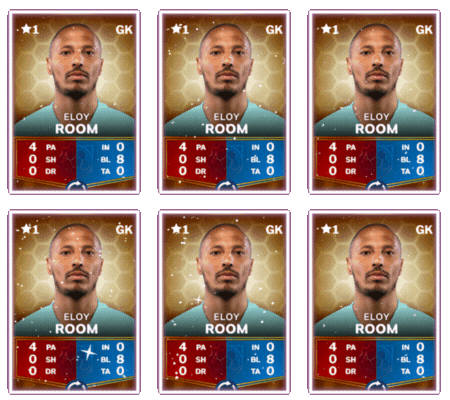
- Player Cards: These cards come in two variants: regular and gold foil, each player card possesses attributes that establish the base starting value for a player's statistics, an interesting detail is that these initial attributes are derived from real-life player statistics, making the game feel more real than it seems, as if you were playing "FIFA" on web3, this creates a logical starting point for the skill and development potential of each digital player, so, if you have knowledge about "Soccer," this game will be very simple for you, in addition to building an incredibly powerful squad (These cards are like the Units/Monsters in Splinterlands).
Once the teams are formed and ready to enter tournament series or ranked play, the action unfolds through a turn-based system requiring continuous strategic decisions, don't worry, I'll explain it below:
During each turn, we receive a hand of up to five players, from this selection, we must choose how the players closest to the ball will behave, decision-making is crucial at this moment, as it determines the flow of the match, while you don't need to be an expert, it's enough to observe the players' stats to know roughly what to play at any given moment.
Once we have performed the chosen action, the game proceeds, the goal is simple: work to tactically outmaneuver our opponent while they try to defend, attack, and ultimately score the winning goal against the other side, it is a normal soccer game, only you are like the puppeteer pulling the strings and deciding every step your players take on the field, your opponent does the same, giving it a brilliant strategic aspect.
This cycle of receiving cards, deciding the action of the player closest to the ball, and then watching the game unfold guarantees that GLG is less of a fast-action game and more of a strategic challenge, here, managing your hand of cards and anticipating the opponent's play are the keys to winning, it's as if the coach were dictating tactical adjustments moment by moment, based on which players are in the best position to influence the game.
The life of a Genesis League Goals team does not end with a simple match. Card management and progression are activities just as important as the match itself, because yes, you can improve over time, the more you play, the stronger you will become, but it is about consistency.
Player cards offer the user the ability to improve their performance through "attached skills", this is undoubtedly one of the deepest aspects of the game.
Basically, you can acquire unique skills, both passive and active, on your player cards, since you can customize players with specific skills, you have the power to create unique cards that not only adapt to your playstyle but also improve their market value, for example, a defender can be upgraded with an active "shot block" skill or a passive "increased stamina" skill, which are basic for a good defense, you get it, right?
After each match concludes, the ideal thing is to dedicate yourself to team management, post-match activities include the following:
- Care and Maintenance: We as coaches must attend to our athletes.
- Roster Management: We must refresh the active team roster (Typical coach duties).
- Trading and Acquisition: We can buy card packs or acquire players directly from the market.
- Card Upgrading: This is a continuous process, as we can improve cards by combining them and optimizing them with new skills and equipment, this constant improvement process is what allows teams to remain competitive as the season progresses.
Conclusion
Genesis League Goals fuses the passion for soccer with the deep strategy of trading card games, success is based not only on the initial choice of players with solid real-world derived stats but also on strategic roster management (7 starters, 5 key substitutes) and tactical capability during turn-based play, where a hand of up to five player cards is managed to influence the match.
Far from being a soccer expert, I have understood every aspect of this game without even playing it, as I dedicated myself to reading the "Whitepaper" to bring you all this information, the truth is that my husband would like to play in fact, while I was telling him how it worked, he commented that he liked it, so, for all those who want to try it, here is all the information.
Arcade Colony Website
Arcade Colony Whitepaper
Genesis League Goals Whitepaper

Join the official Arcade Colony community here Discord